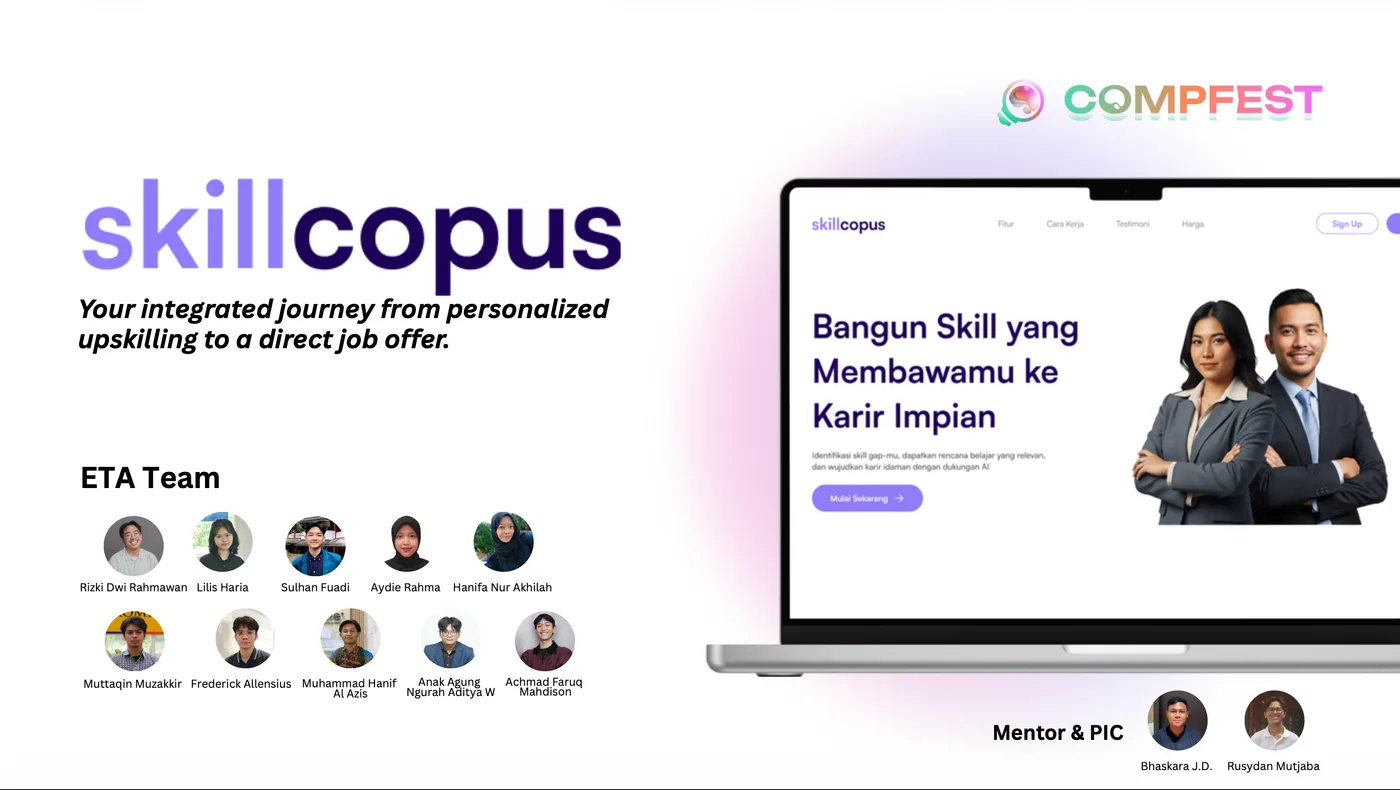
The concept was anchored in skill mismatch, low credential trust, passive learning, and fragmented pathways.
Skillcopus
Skillcopus was framed as a strategic response to talent-market mismatch, connecting assessment credibility, learning progression, and employability signals in one product blueprint.
A source-backed case study built for recruiter review
This reading path makes the problem choice, evidence quality, user framing, execution decisions, and proof trail visible without overstating what the sources support.
AI-assisted upskilling platform concept designed to close skill mismatch and improve employability pathways.
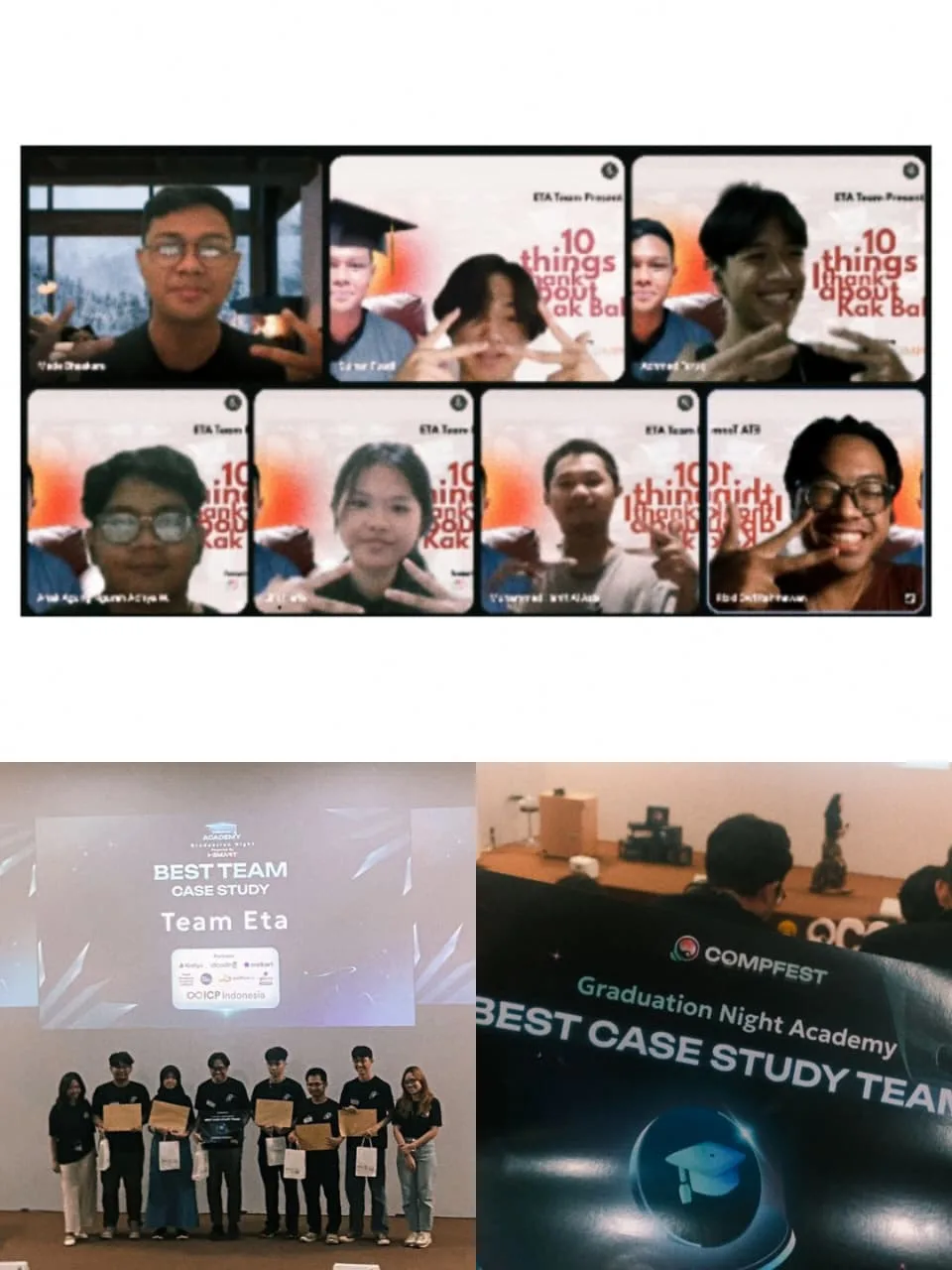
Strengthened strategic portfolio depth through best-team-level product case delivery in COMPFEST context.
Product blueprint integrating assessment, learning progression, and outcome-tracking modules.
Problem framing before execution
The case-study layer starts with why this problem was selected and how the context justified investment.
Problem Framing Map
Upskilling ecosystems often suffer from weak industry alignment, low credential trust, and fragmented learning-to-employment journeys.
Skillcopus was built as a strategic product concept inside a competition context, so the value is in diagnosis quality, user framing, and coherent product architecture rather than coded implementation.
The problem matters because employability products fail when they optimize learning activity without proving skill credibility or outcome progression.
Problem statement
Existing upskilling ecosystems showed weak industry alignment, low credential trust, and fragmented user journeys.
Solution thesis
Designed an integrated upskilling experience connecting practical learning, credible assessment, and employability progression.
What supports the narrative
Evidence is surfaced with its source type and credibility note so the recruiter can quickly see what is directly backed versus intentionally constrained.
The outcome included PRD, roadmap, and a final narrative that connected assessment, learning, and employability modules.
Credibility Notes
- ●The project is presented as product strategy and case-study work, not as a deployed upskilling platform with verified hiring outcomes.
- ●Recruiter-facing copy should not imply pilot usage, learner completion, or placement performance beyond what sources document.
User framing stays explicit
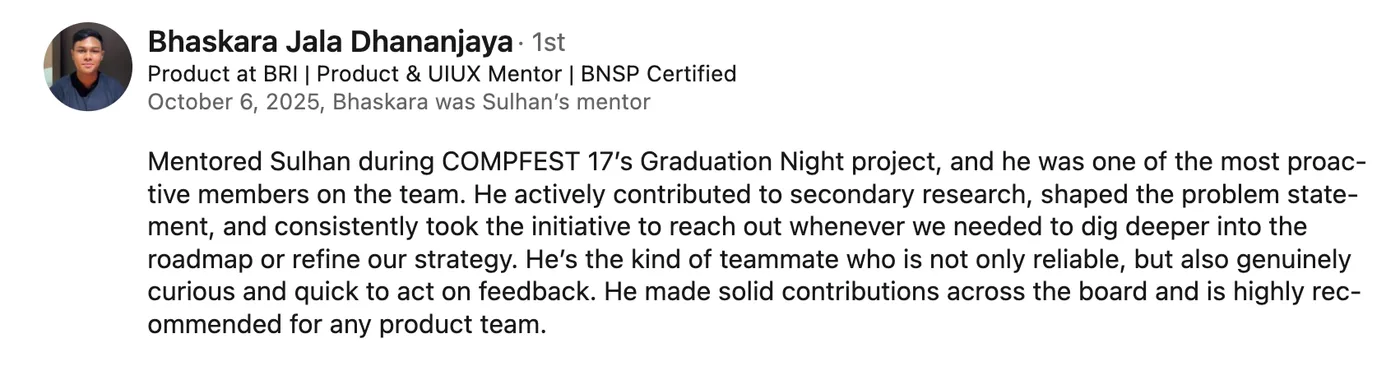
When formal research artefacts are not available, the page still explains who the work served and why that user framing is justified by the existing sources.
The solution explicitly connects practical learning, assessment credibility, and progression outcomes.
Credential trust and employability matching are central to the diagnosed problem.
How design thinking translated into decisions
The goal is to show the trace from research and insight to concrete product or system decisions, then to the outcomes those decisions supported.
Design Thinking Flow
Each step keeps the movement from evidence to action explicit before the rationale expands it.
- Step 1Root-cause mapping
Diagnosed the market problem as a pathway and trust issue, not only a content-access issue.
Signal: Skill mismatch and credential credibility became the starting frame. - Step 2User-journey synthesis
Mapped value proposition and journey logic to connect assessment, learning, and job outcomes.
Signal: The product blueprint follows progression rather than isolated features. - Step 3Strategic packaging
Consolidated the solution into a PRD, roadmap, and cross-functional recommendation set.
Signal: The concept is reviewable as a handoff-ready product case.
Decision Rationale
Each decision keeps the path from insight to execution visible before ending on the outcome signal.
Upskilling products lose recruiter trust when outcomes are not tied to credible proof.
Positioned assessment and employability signals as core modules, not optional add-ons.
The concept differentiates itself on proof of readiness, not only on content delivery.
The biggest uncertainty was product-system design, not UI polish.
Prioritized validated product architecture over premature implementation depth.
The case reads as a strong product-thinking artefact for recruiter review.
Execution choices and delivery details
This section preserves the technical and operational substance: architecture, responsibilities, trade-offs, and implementation quality signals.
System Design
Product blueprint integrating assessment, learning progression, and outcome-tracking modules.
Source-backed Impact
Strengthened strategic portfolio depth through best-team-level product case delivery in COMPFEST context.
Responsibilities
- ●Led strategic problem diagnosis and solution framing
- ●Mapped value proposition and user journey logic
- ●Consolidated cross-functional product recommendations
Stack Decisions
- ●Prioritized validated product architecture over premature technical implementation
Trade-offs
- ●Focused on strategic completeness rather than feature prototyping depth
Challenges
- ●Translating national-level skill-gap insight into actionable product modules
Architecture and outcome snapshot
This visual layer keeps execution readable: how the system or delivery flow was structured and which source-backed outcomes mattered most.
Execution Flow
- Step 1Root-Cause Diagnosis
Mapped systemic gaps: skill mismatch, low credential trust, passive learning, and fragmented pathways.
Signal: Problem framing built from upskilling ecosystem breakdown - Step 2Integrated Product Blueprint
Designed connected modules across practical assessment, AI-assisted learning, and employability matching.
Signal: Solution tied learning outcomes to career progression signals - Step 3Cross-Functional Delivery
Consolidated strategy into PRD, roadmap, and final narrative with multidisciplinary collaboration.
Signal: Best Team context reached in COMPFEST academy setting
Outcome Snapshot
- OutcomeBest Team context
Strategic product case recognized in COMPFEST 17 track
- Primary UsersJob seekers + recruiters
Persona mapping connected demand and talent-side needs
- Delivery AssetPRD + roadmap + pitch
Decision-ready product artifacts packaged for execution
What was delivered and what can be verified
Outcome claims remain conservative and source-backed, while proof records and recruiter-safe links surface the strongest verification trail available.
Validation Signals
- ●Best Team context in the COMPFEST academy setting.
- ●PRD, roadmap, and pitch assets are documented as core delivery outputs.
Source-backed Outcomes
- ●Positioned as best-team strategic output in academy context
Proof
- Best Team Context
Strategic product case delivered
COMPFEST 17
Links
What the project proves, and what it does not
Strong case studies show both what was learned and where the current evidence stops.
Retrospective
The concept should advance through pilot cohorts and measurable hiring-related KPIs.
Evidence Limits
- ●Current sources do not provide pilot cohort metrics, learner outcome data, or recruiter adoption evidence.
- ●The concept should be interpreted as strategy-backed product thinking rather than validated market traction.
Lessons
- ●Credibility in upskilling products depends on proof of learner outcomes