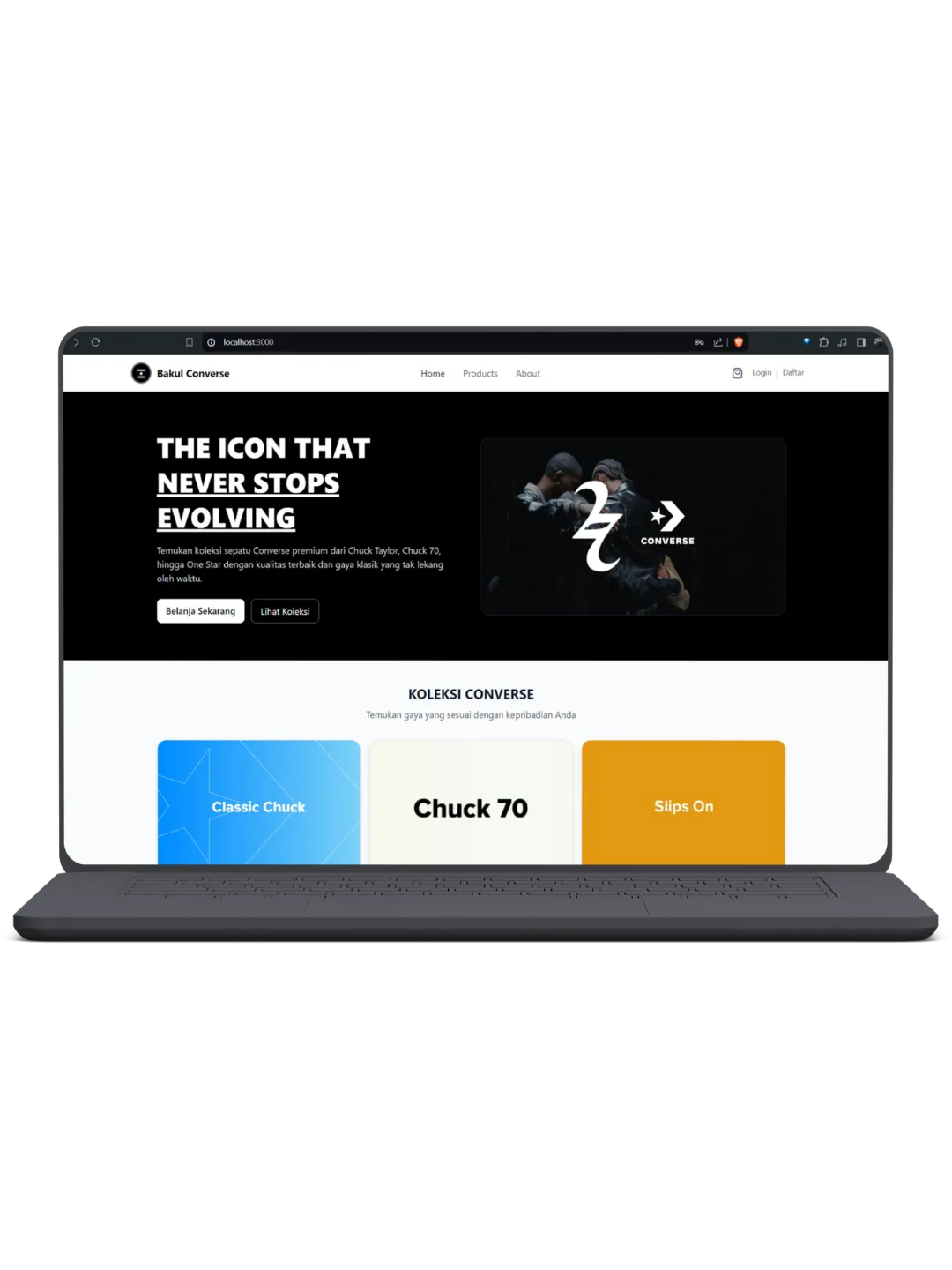
The project explicitly covers auth, catalog exploration, cart, checkout, and admin operations.
Toko Online (Bakul Converse)
Built as a midterm project for Platform-Based Development, this team delivery turns standard commerce journeys into a structured end-to-end workflow across user and admin portals.
A source-backed case study built for recruiter review
This reading path makes the problem choice, evidence quality, user framing, execution decisions, and proof trail visible without overstating what the sources support.
Course-delivered full-stack e-commerce build covering customer storefront and admin operations in one product flow.
Delivered a complete storefront-to-admin commerce prototype with pragmatic architecture choices that supported fast team execution.
Next.js full-stack app with Supabase-backed persistence and API route orchestration.
Problem framing before execution
The case-study layer starts with why this problem was selected and how the context justified investment.
Problem Framing Map
Team-based commerce builds become hard to evaluate when storefront, admin, and shared integration logic are not organized into one coherent product flow.
Toko Online (Bakul Converse) is documented as a course-delivered fullstack e-commerce project that covers customer storefront and admin operations in a shared codebase.
It is a good final candidate because it adds team-based commerce delivery and pragmatic integration thinking without depending on speculative business claims.
Problem statement
The course scope required an end-to-end commerce platform for customer flows and operational admin management.
Solution thesis
Built integrated product, cart, checkout, and admin capabilities on a shared full-stack application baseline.
What supports the narrative
Evidence is surfaced with its source type and credibility note so the recruiter can quickly see what is directly backed versus intentionally constrained.
The project narrative highlights schema consistency, API coordination, and shared interface contract alignment.
Credibility Notes
- ●The case is framed as academic fullstack commerce delivery, not as a validated operating store with real transaction metrics.
- ●No conversion, order-volume, or production-operations claim is introduced beyond the source-backed project scope.
User framing stays explicit
When formal research artefacts are not available, the page still explains who the work served and why that user framing is justified by the existing sources.
The clearest source-backed value lies in the end-to-end commerce scope across customer and admin journeys.
The project’s core strength is pragmatic integration and interface coordination under team-delivery constraints.
How design thinking translated into decisions
The goal is to show the trace from research and insight to concrete product or system decisions, then to the outcomes those decisions supported.
Design Thinking Flow
Each step keeps the movement from evidence to action explicit before the rationale expands it.
- Step 1End-to-end journey framing
Started by defining the commerce product as one flow across auth, browsing, checkout, and admin operations.
Signal: The project scope stays centered on coherent journey coverage. - Step 2Single-repo integration
Used API routes and Supabase-backed persistence to keep business logic and delivery coordination close.
Signal: The project reads as pragmatic fullstack integration rather than fragmented modules. - Step 3Team convergence discipline
Aligned team-owned modules through schema and interface consistency.
Signal: Collaboration quality became part of the engineering story.
Decision Rationale
Each decision keeps the path from insight to execution visible before ending on the outcome signal.
Storefront and admin capabilities become harder to reason about when they evolve without one shared product structure.
Defined the project around a connected storefront-to-admin workflow.
The system reads as a single commerce product instead of unrelated pages.
Academic teams move faster when auth, persistence, and route logic can be integrated without heavy infrastructure setup.
Used Supabase and API routes to consolidate the backend pattern in one repo.
The project balances delivery speed with enough architectural coherence for review.
Execution choices and delivery details
This section preserves the technical and operational substance: architecture, responsibilities, trade-offs, and implementation quality signals.
System Design
Next.js full-stack app with Supabase-backed persistence and API route orchestration.
Source-backed Impact
Delivered a complete storefront-to-admin commerce prototype with pragmatic architecture choices that supported fast team execution.
Responsibilities
- ●Implemented assigned modules across auth and commerce flow
- ●Collaborated on data schema and API consistency
- ●Supported integration and debugging across team modules
Stack Decisions
- ●Chose Supabase for rapid backend provisioning
- ●Used API routes to consolidate business logic in one repo
Trade-offs
- ●Accepted platform abstraction limits to accelerate team delivery
Challenges
- ●Synchronizing multi-member implementation in a short academic timeline
Architecture and outcome snapshot
This visual layer keeps execution readable: how the system or delivery flow was structured and which source-backed outcomes mattered most.
Execution Flow
- Step 1Commerce Scope Framing
Defined end-to-end journey across auth, catalog exploration, cart, checkout, and admin operations.
Signal: User flow and operator flow planned in one platform baseline - Step 2Full-stack Integration
Connected frontend and backend logic through API routes with Supabase-backed persistence.
Signal: Single codebase delivery reduced handoff overhead - Step 3Team Module Convergence
Aligned team-owned modules into consistent schema, contract, and transaction behavior.
Signal: Cross-module integration completed within academic timeline
Outcome Snapshot
- CapabilityStorefront + admin workflow
Core commerce and operational pathways delivered
- Backend PatternAPI routes + Supabase
Business logic and data layer integrated in one repo
- Delivery ContextTeam-based full-stack build
Module ownership coordinated under shared interface contract
What was delivered and what can be verified
Outcome claims remain conservative and source-backed, while proof records and recruiter-safe links surface the strongest verification trail available.
Validation Signals
- ●End-to-end storefront and admin flow is documented as delivered.
- ●The visual snapshot records cross-module integration completed within the academic timeline.
Source-backed Outcomes
- ●End-to-end storefront and admin flow delivered
Proof
- Academic Project
Midterm project delivered
PBP Course
Links
What the project proves, and what it does not
Strong case studies show both what was learned and where the current evidence stops.
Retrospective
Next iteration should include stronger role-based access and transaction analytics.
Evidence Limits
- ●Current sources do not provide real transaction metrics, production deployment evidence, or customer adoption outcomes.
- ●The project should remain framed as academic fullstack commerce delivery and integration proof.
Lessons
- ●Module ownership must be paired with strict interface contracts